Why TWINT Is Non-Negotiable for Selling in Switzerland
TWINT has over 5 million active users in Switzerland. If your Shopify store doesn't offer it, you're losing sales at checkout. Here's what you need to know.
Monday morning. You check your Shopify dashboard. A Swiss customer added CHF 240 worth of products to their cart. Got all the way to checkout. Then left.
You check the analytics. No payment error. No shipping issue. They simply didn't find the payment method they expected.
I've seen this happen dozens of times in 8 years of building eCommerce stores in Switzerland. The brand owner stares at the abandoned cart report and asks: "But we accept Visa and Mastercard — what else could they want?"
TWINT. They wanted TWINT. And you didn't have it.
What is TWINT?
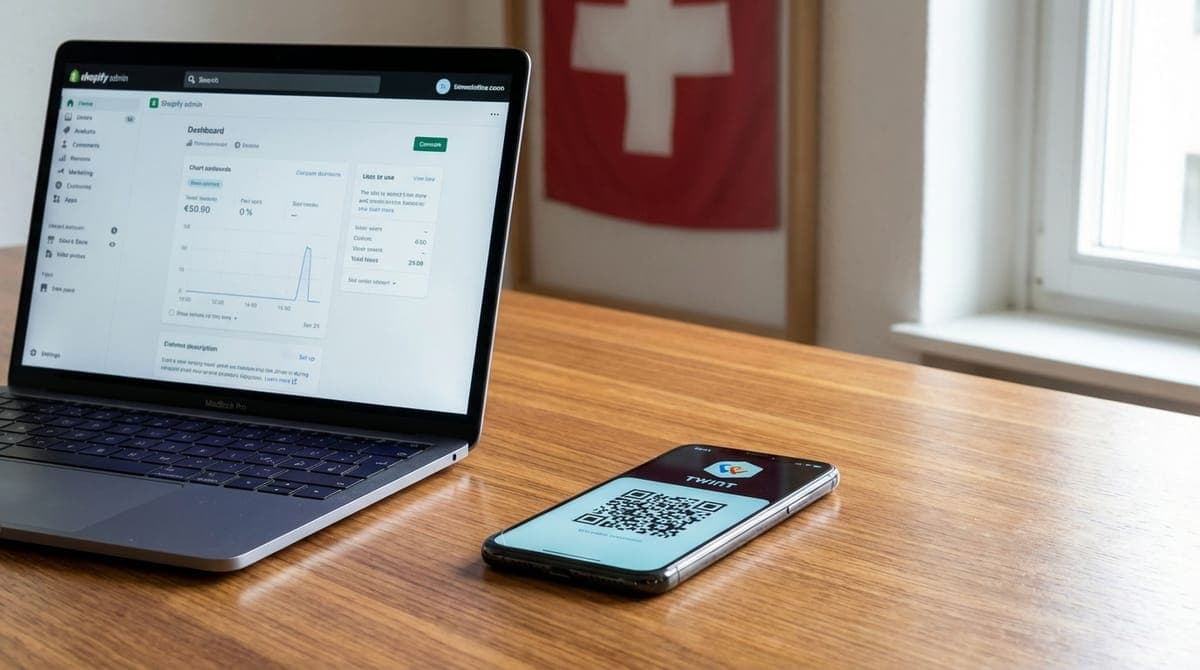
TWINT is Switzerland's leading mobile payment app with over 5 million active users — in a country of 9 million people. Consumers pay by scanning a QR code or confirming a push notification from their bank. It's backed by every major Swiss bank: UBS, PostFinance, Raiffeisen, ZKB, and others. For eCommerce stores targeting Swiss consumers, TWINT integration is not optional — it's expected.
Think of it as the Swiss equivalent of iDEAL in the Netherlands or Klarna in Germany. Not offering it at checkout is like opening a physical store in Zurich and refusing cash. Technically possible. Commercially suicidal.
Why foreign brands keep getting this wrong
When I worked on the ALDI Switzerland online launch, one of the first things we validated was the payment stack. TWINT was non-negotiable. The internal data showed that 25-30% of Swiss online shoppers prefer TWINT over credit cards, especially in the 18-45 age range — exactly the DTC sweet spot.
But most foreign brands entering Switzerland don't know this. They build their store, add Stripe, maybe PayPal, and wonder why conversion rates are 20% below European benchmarks.
The problem isn't their product. It's their checkout.
How TWINT online payments work
Unlike card payments where the customer enters a number, TWINT uses a redirect flow:
- Customer selects TWINT at checkout
- On desktop: a QR code appears. On mobile: the TWINT app opens directly
- Customer confirms the payment in their TWINT app
- Payment is confirmed and the customer returns to your store
The mobile experience is seamless — a simple app switch, like opening a link. On desktop, it's similar to logging into WhatsApp Web. The entire process takes under 10 seconds.
5 steps to integrate TWINT with Shopify
- Choose a TWINT-certified payment service provider (PSP) — Shopify Payments, Datatrans, Wallee, or Wordline
- Set up your Swiss business entity — most PSPs require a GmbH or Einzelfirma and a Swiss bank account
- Install and configure the PSP's Shopify integration — native for Shopify Payments, app-based for third parties
- Ensure CHF is your store currency — TWINT only processes in Swiss francs
- Test with a real TWINT account — there's no traditional sandbox, so run a real CHF 1.00 transaction end-to-end
Which payment provider should you use?
| Scenario | Provider | Why |
|---|---|---|
| Swiss GmbH + Shopify + starting fresh | Shopify Payments | Native TWINT, no extra fees, unified reporting |
| No Swiss entity yet | Datatrans or Wallee | Can process for some non-Swiss entities |
| Already using Stripe | Add Datatrans as secondary | Stripe may not support TWINT in your config |
| High volume (CHF 500K+/year) | Wordline | Enterprise-grade, direct TWINT acquirer contract |
| Multi-country store | Wallee | Payment orchestration across markets |
If you have a Swiss GmbH and a Shopify store, Shopify Payments with native TWINT is the fastest path. Enable it under Settings → Payments → Alternative payment methods. No extra contracts, no setup fees.
For stores without a Swiss entity, Datatrans is the most established Swiss gateway — it also gives you PostFinance, Reka, and Swiss credit card processing in one integration.
The 5 mistakes I see every brand make
After 8 years building stores for the Swiss market — including enterprise operations like ALDI Suisse and Jumbo.ch — these are the patterns I see repeated:
1. Not offering TWINT at all
The most expensive mistake. You're leaving 15-30% of potential conversions on the table. Every. Single. Day.
2. Burying it below other payment options
TWINT should be the first or second option at checkout — right after credit card. Don't hide it under "Other payment methods." Swiss shoppers scan for the TWINT logo instinctively.
3. Ignoring the checkout language
Your checkout says "Pay with TWINT" in English. Your customer's browser is in German. It feels wrong. Localize your checkout in DE, FR, IT, and EN. Switzerland has four official languages — your checkout needs at least three.
4. Forgetting TWINT refunds are different
TWINT refunds process as bank transfers, not card reversals. The timing is different. Your customer service team needs to know this, or they'll promise "refund in 3-5 days" when it might take longer.
5. Using a pixelated TWINT logo
Sounds minor. It's not. A blurry or incorrectly colored TWINT logo signals "this store doesn't really know what they're doing." Download the official assets from the TWINT partner portal. Swiss consumers notice.
The bigger picture: your Swiss payment stack
TWINT is essential, but it's one piece. A complete Swiss checkout needs:
- Credit/debit cards — Visa, Mastercard (essential)
- TWINT — 5M+ users (essential)
- PostFinance — many Swiss still use it as primary bank (important)
- Kauf auf Rechnung — invoice payment, trusted for higher-value items (important)
- PayPal — familiar to international customers (optional)
And payments are just the start. You also need to handle Swiss VAT (MwSt at 8.1%), nFADP compliance, logistics with Die Post, and legal pages — Impressum, AGB, Datenschutzerklärung. I'll cover each in upcoming guides.
If you're building a Shopify store for Switzerland and want the payment stack done right from day one, let's talk about your project.
Keep reading

What a Hospital Bed Taught Me About eCommerce
eCommerce StrategyFrom 15 surgeries to launching ALDI's Swiss online store at midnight. 25 years in eCommerce, 8 years in Switzerland. This is how I got here.

The World's Highest-Value Online Shopper Lives in Switzerland
Swiss MarketThe average Swiss online order in 2024 was $239 — more than double the global average, and the highest of any country on earth. So why do most European DTC brands skip this market entirely?